How-to
Food puzzles for cats: how to make mealtime a hunt
Why vets recommend puzzle feeders for indoor cats, the main types, how to introduce one step by step, and when to watch your cat's weight and call the vet.
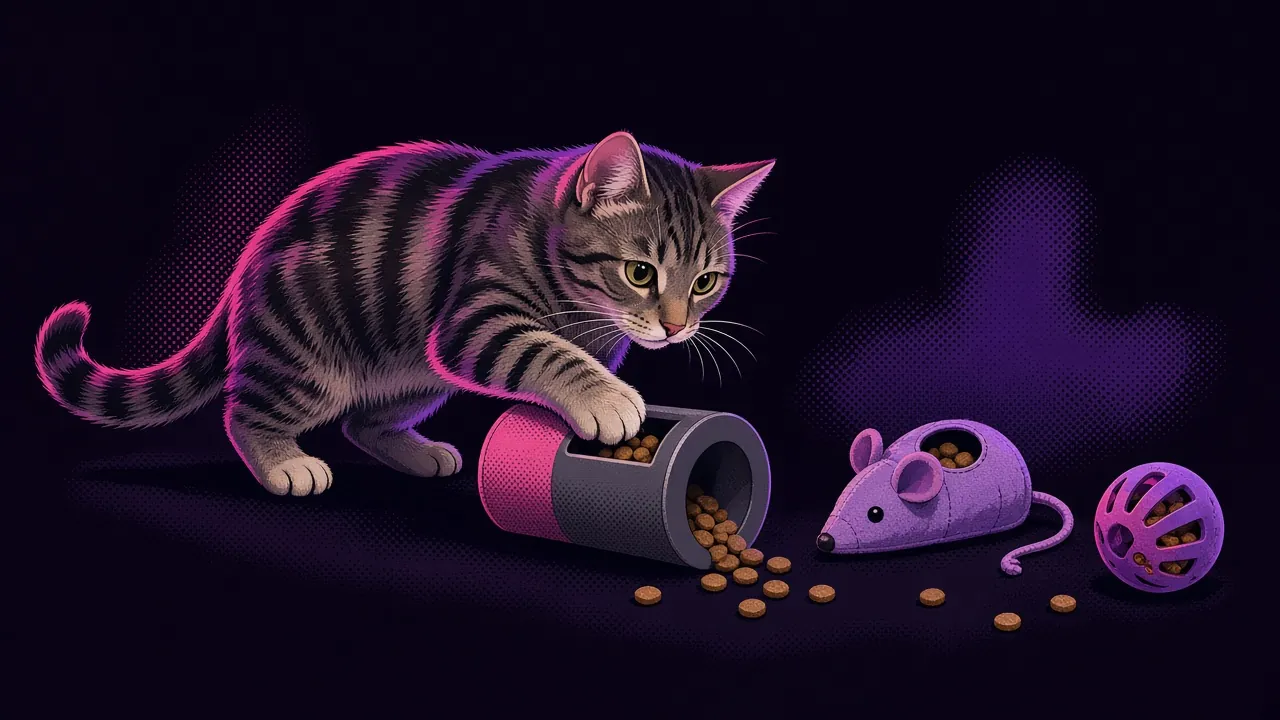
Most indoor cats get their food the same way every day: a full bowl, once or twice, in the same spot. That's easy for us, but it skips everything a cat is built to do before eating. Food puzzles put a little of the hunt back into mealtime, and feline vets have been recommending them for years.
Why vets recommend them
In 2018 the American Association of Feline Practitioners (AAFP) published a consensus statement on how to feed cats, in the Journal of Feline Medicine and Surgery. It explains that an indoor lifestyle can prevent normal behaviors like hunting and foraging, which hurts a cat's welfare, and that behavior problems are more common in cats without outdoor access.
The statement says puzzle feeders and hiding kibble around the home increase activity, provide mental and physical stimulation, and help with weight management. According to the AVMA's summary, letting cats eat more naturally can help ease or prevent stress-related issues such as cystitis and obesity-related problems like inactivity and overeating.
The AAFP's core advice is simple:
- Split your cat's daily food into several small meals instead of one or two big ones.
- Use puzzle feeders when you can.
- Hide some portions in different spots, including up high if your cat is fit enough to reach them.
- In multi-cat homes, give each cat its own food and water station.
The main types of food puzzles
Food puzzles are any object that holds food and has to be moved or worked to release it. A review on food puzzles in the same journal sorts them into a few groups:
- Stationary puzzles. They stay put while your cat paws food out of tubes, wells or slots. A good starting point for most cats.
- Rolling puzzles. Balls or tubes your cat bats around to make kibble fall out. These add more movement, but they only work with dry food.
- Hide-and-hunt feeders. Small "prey" feeders you fill and hide around the house, so your cat has to search for each portion.
- Homemade puzzles. An empty paper towel tube or egg carton with a few kibbles inside works too, and costs nothing.
Some puzzles are made for dry food and some can take wet food, so check before you buy.
How to introduce a puzzle, step by step
The biggest mistake is starting too hard. The food puzzle review says that at first, getting food from the puzzle should be as easy as getting it from the bowl.
- Make it easy. Fill the puzzle as full as you can. For a stationary puzzle, let the cups overflow. For a rolling one, open the holes to the widest setting.
- Pick the right moment. Offer it when your cat is likely to be hungry, such as right before a usual mealtime.
- Start with something special. A favorite treat in the puzzle builds interest. Switch to regular food once your cat gets the idea.
- Help them connect the dots. For dry food puzzles, scatter some kibble on the floor around the puzzle. As your cat eats, it bumps the puzzle and learns that moving it makes food appear.
- Raise the challenge slowly. Only make it harder once your cat empties the easy version without fuss.
Keep the regular bowl available while your cat is learning. A few days of mixed meals beats a hungry, frustrated cat.
Our picks to start with
A stationary tube feeder is the gentlest first puzzle. The Catit Senses 2.0 Digger has three short, narrow tubes and two long, wide ones on a stable base with a rubber mat, so it doesn't slide around.
Once your cat is a pro, a board with several different challenges keeps things interesting. The TRIXIE Fun Board has five modules and non-slip pads.
For cats with a strong hunting drive, hide-and-hunt feeders come closest to the real thing. Doc & Phoebe's kit includes a trainer and three fabric-skinned mouse feeders that you fill and hide around the house.
A rolling ball adds exercise. The PetSafe SlimCat has adjustable openings so you can set how fast kibble comes out.
Keep an eye on the scale
Puzzles make eating slower, so check that your cat is still getting enough. The AAFP stresses that owners must make sure their cat is actually eating an appropriate amount, especially older cats, cats with chronic illness and cats in multi-cat homes. Automatic feeders can help with portion timing, but the AAFP notes they don't usually provide for hunting or foraging.
Call your vet if your cat:
- Stops eating or eats much less than usual
- Loses or gains weight you didn't plan for
- Guards food from other pets, or a shy cat stops coming to meals
Your vet can also tell you how many calories your cat needs per day, which makes splitting meals into puzzle portions much easier.
Pair it with play
Food puzzles work best alongside short play sessions that let your cat stalk, chase and pounce. See our guide to wand toy play for indoor cats, and if you use more dry food in puzzles, our tips to get your cat to drink more water.
For more feeders, fountains and lick mats, see the best slow feeders, lick mats and water fountains. For toys, see the best cat scratching posts and interactive toys.
Sources: American Association of Feline Practitioners, "Feline feeding programs: Addressing behavioural needs to improve feline health and wellbeing," Journal of Feline Medicine and Surgery (2018); AVMA News, "AAFP releases consensus statement on how to feed a cat"; "Food puzzles for cats: Feeding for physical and emotional wellbeing," Journal of Feline Medicine and Surgery; AAFP Cat Friendly Homes, "How to Feed Cats" brochure; manufacturer product information for Catit, TRIXIE, Doc & Phoebe's and PetSafe.